
Industry
Healthcare, Pharmaceuticals
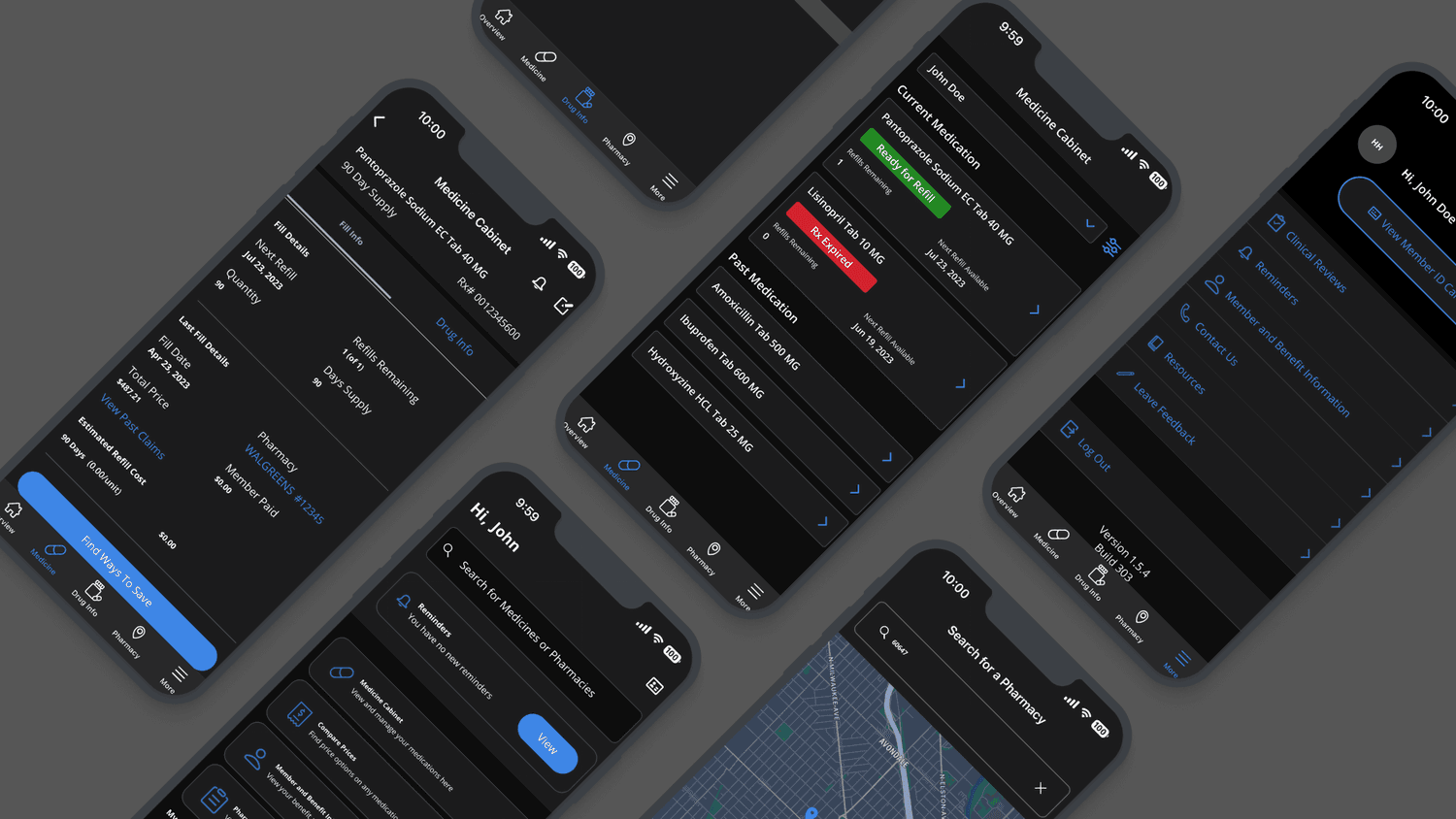
HCSC was looking to create a pharmaceutical app to allow customers to easily find cost savings opportunities, refill prescriptions, learn about their drugs and more. They had the data, but needed someone to take charge of a small team and get the work done.
I took charge of the team and, in addition to doing UX design and strategy work, directed a Jr. UXD and a visual designer throughout the process. The app was launched within 6 months time, and now exists within the BCBS app, garnering over 4.7 stars from 19,000+ ratings.
GETTING STARTED
The healthcare industry is a constantly evolving industry with new technology, competitors, and products being introduced. Even for a healthcare provider it can be hard to consistently keep up with the new expectations from customers. This gap in understanding customer’s needs though is where the field of Design thrives. We designers can come in and help large companies empathize with users and strategize what would be necessary for an MVP that will meet the needs of this ever-changing industry. This is exactly what we did for HCSC, help them create a way for customers to easily engage with their pharmaceuticals and pharmacies in their area.
Starting out this project consisted of myself as the UX Lead, A Principal, and a Solution Owner. As we worked and the scope grew throughout the project we ended with:
1 UX Lead (Me)
1 UX Designer
1 UI Designer
2 Principals
1 Solution Owner
1 Solution Architect
LAYING THE GROUNDWORK
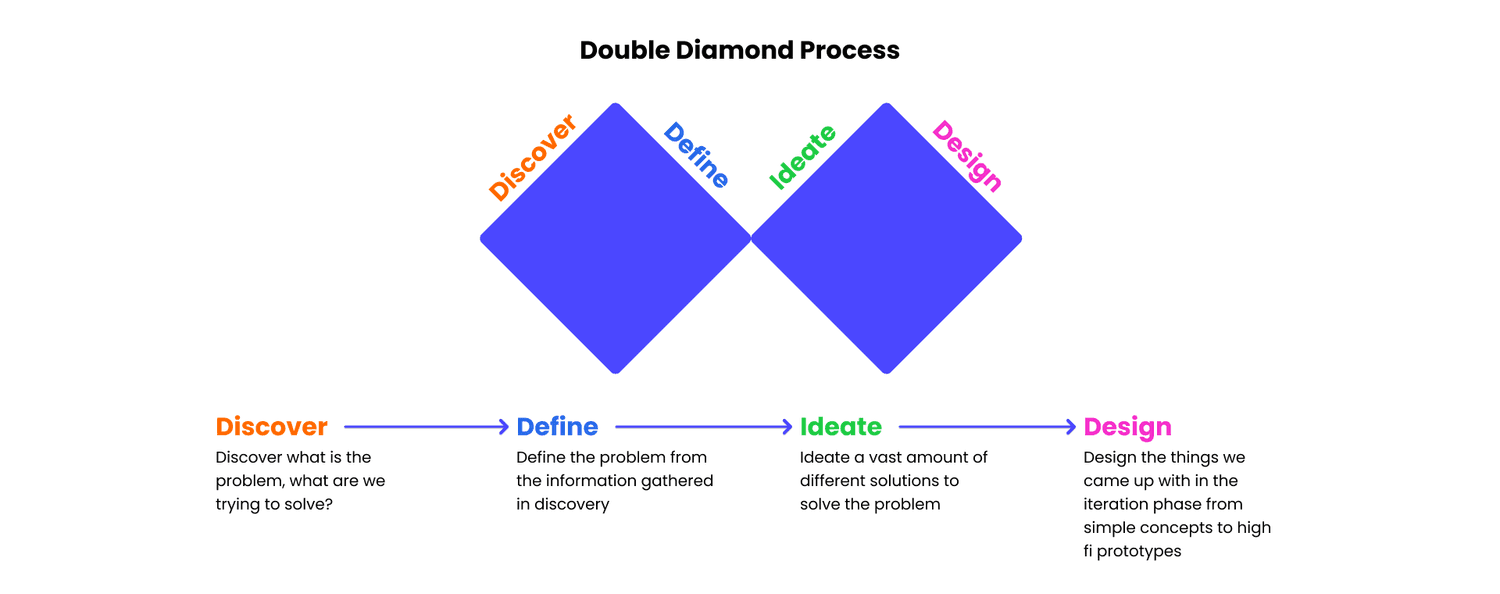
This was my first foray into being a UX design lead for a project, and early on I figured it would be important to define the features of the MVP, as well, as the timeline we would be reviewing and delivering each of them. Working with the principal on the project and a solution architect (A project manager with a little bit more knowledge of a specific industry/subject) we came up with our list of features. This was through a combination of user research conducted by the research team at HCSC as well as a lot of competitive analysis I conducted, looking at competitors' apps, reading reviews/frustrations online about other healthcare providers, and speaking to friends and family about their private health insurance Rx. We also looked at the lifecycle of a prescription for a patient and created a service blueprint that would help us focus on any frustrations or key touch points that the patient may face.
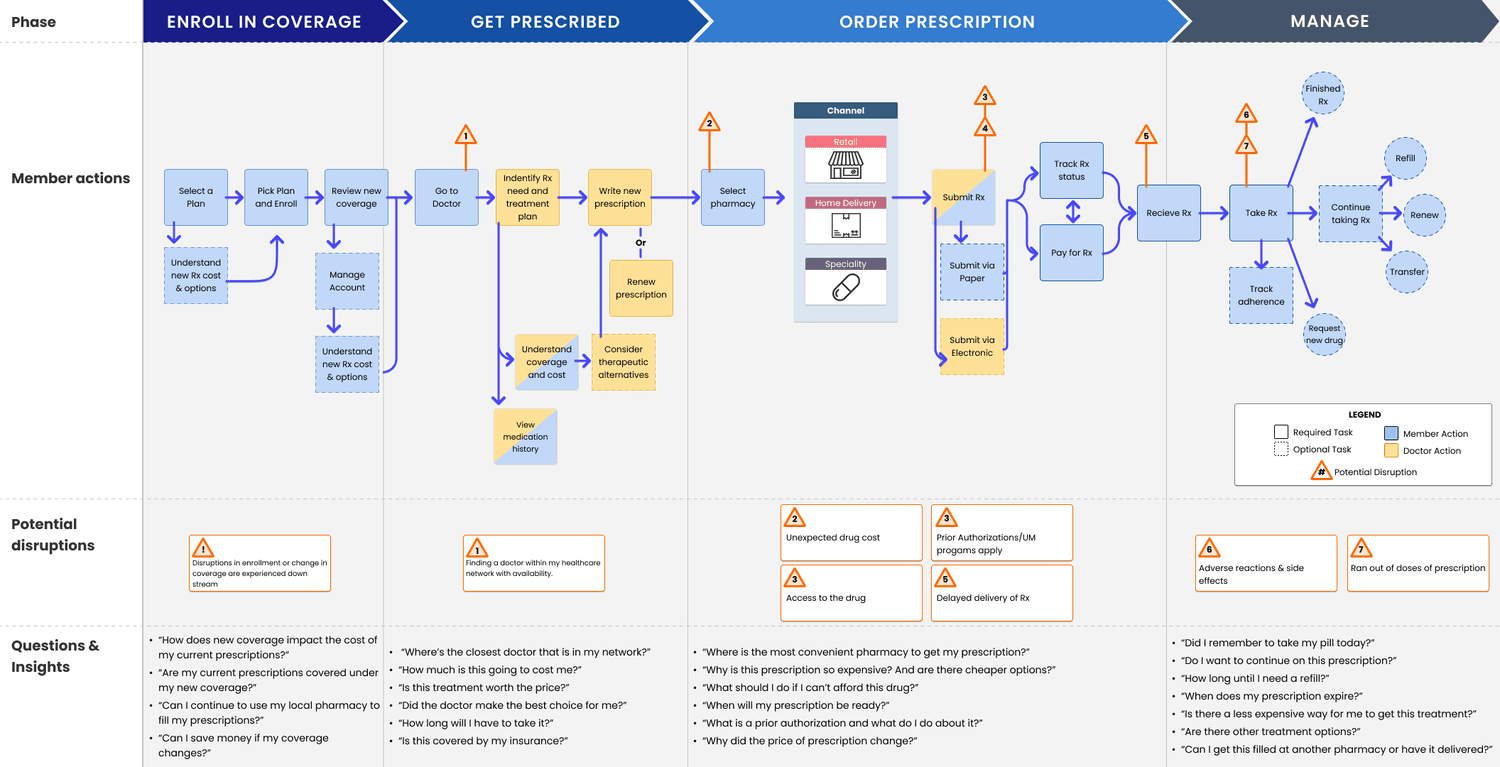
With all of this in hand, we knew where we had to focus our attention for the MVP. Our North Star was to allow customers to track and manage Rx conveniently and efficiently from anywhere they were. This led us to this list of key features:
View personal prescriptions and family member's prescriptions
Learn more about the medicines in your cabinet and any other medicines a patient may take
Find and view details about pharmacies in their area
Compare prices between pharmacies for any medication
View member and benefit details
Receive reminders about changes to Rx and when to refill
View Pharmacy Claims
DELIVER ON TIME
We needed to ensure to our client that we would deliver these designs on time and ready for development. At this point the developers were still forming the team and discussing backend capabilities based on our feature set provided, as well we were going to be working using Agile methodology to be in lockstep with the development team. This meant we were staggering our designs out by each 2-week sprint, allowing the team to have ample time to design, get feedback, and get approval from our client.
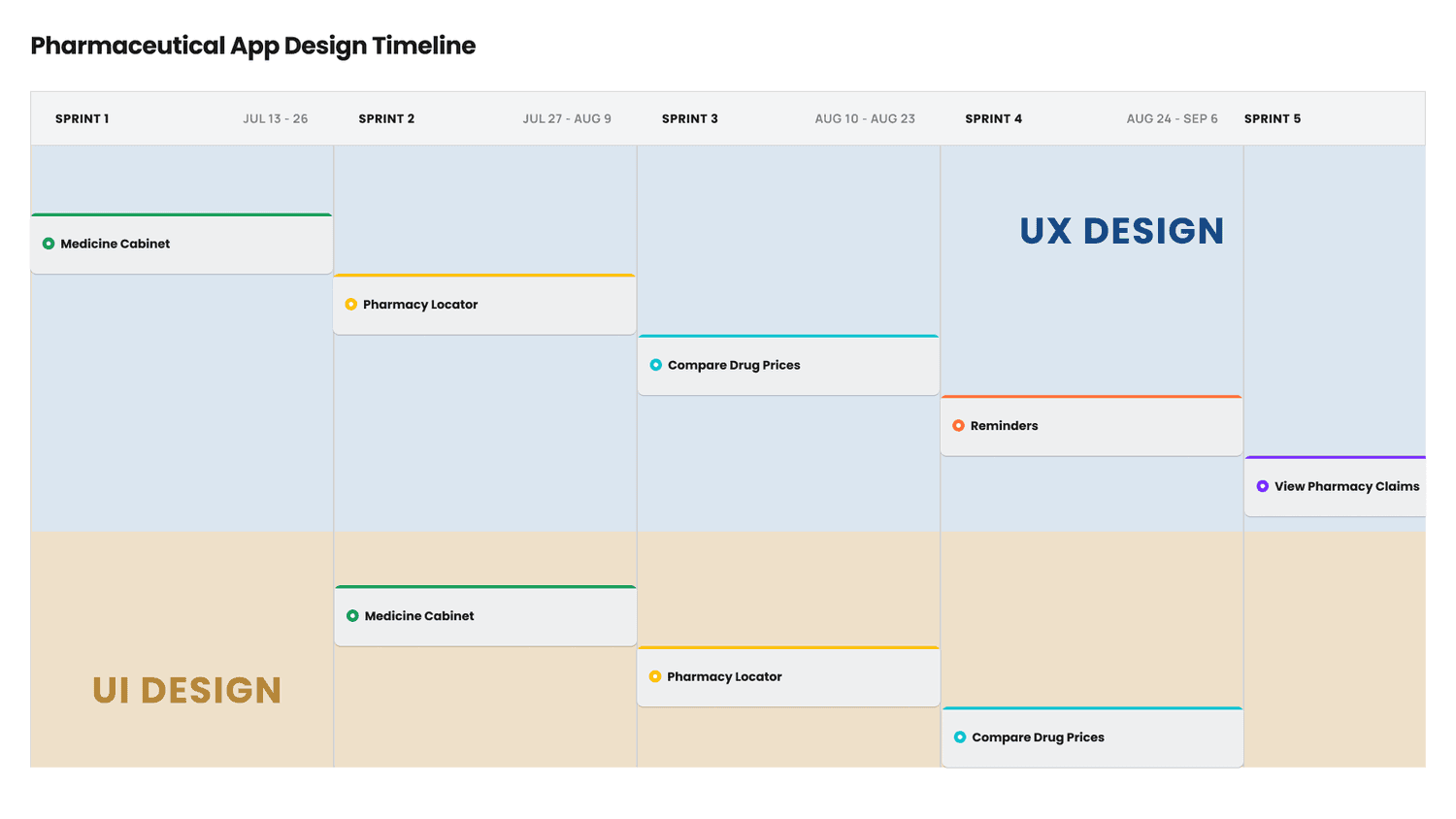
(This is a representative of the actual delivery timeline we worked with)
Having built out the timeline allowed myself and the team to set expectations with our client and broader team. This also meant when new members of the team joined we could properly align them to what was left to be built, decreasing the time required for knowledge transfers. I wanted to focus on full features at a time, especially because this was a completely new product, that way we could provide the client with a more full version of the experience from our view so that we could gather more constructive and specific feedback about the features and align our view with theirs.
To make sure we were getting ample feedback from our client, I decided to have bi-weekly (two times a week) design reviews with our stakeholders. This call consisted of my team of designers as well as the Principal and Solution owner, from the client’s side they had the senior manager of design joining, a senior UX Designer, and then a senior manager of Dev/Tech and anywhere from 1-3 developers joining. This open form of communication and feedback from all sources allowed for designs to be translated very easily from design to development, and quicker approvals from our client because all parties were present and aligned.
Along with this, the design team joined the development daily stand-ups and development sprint kick-offs to make sure that when our designs were sent over with annotations there was no ambiguity in them and the team would not have any blockers when working through them. In doing so we garnered an incredible amount of trust and buy-in from our client that me and my team were here to help create a solution in tandem with them, rather than just being like any other consultancy out there in the market. This level of trust went a long way into getting sign-off on designs too which helped alleviate any potential stressors coming up from project deadlines.
When it came to getting user feedback and testing the app my team and I worked in tandem with the research team at HCSC to get feedback and implement any design changes. We supplied them with finished designs of the feature sets as well as goals intended for the screens provided to which the research team created a test plan around those goals and set up testing sessions with users they had curated. This allowed my team to focus on making quick changes to the feedback we heard during the testing sessions, which then allowed us to create a more user-friendly and engaging experience that met users.
WRAP UP
This project really helped grow my strengths as a lead and focus on helping guide others through the fundamentals of a UX project, not only from the perspective of teaching other designers but also educating clients and consulting team members on what tasks were necessary to complete a design project of this nature. My growth throughout this project also included some learnings as I matured in the field of design. I learned that creating timelines early is not only for the sake of the designers but also for the sake of the client and setting expectations, which goes a long way. When you have these clear goals and timelines set out, every part of the triad can point back to those timelines and know A. Where the project is estimated to be, at any time during the project, and B. Estimate future efforts, which helps to get the right people in the room at the right time. I also learned the importance of working more closely with developers. In my past design work I worked with developers but only in the aspect of handing off designs, but for this project I had to make sure that the design goals were clearly understood by developers and the feasibility of this project was actually so. This was added work on my plate specifically but I’m glad I worked so closely with the team of developers so 2,3,4, etc. months down the line from when the project started, we didn’t have unfixable issues come up. I learned so much and really feel the growth as a designer from this project, not only did I walk away with my learnings but I walked away with a new sense of confidence to lead projects, designers, and teams to success.